
Direct Answer: Yes, new insulation qualifies for a home energy tax credit if it meets IRS and ENERGY STAR criteria under the Energy Efficient Home Improvement Credit. Qualifying materials—fiberglass, cellulose, and spray foam insulation—earn homeowners 30% of installation costs, up to $1,200 annually. In contrast, insulation that fails to meet U.S. Department of Energy R-value requirements or lacks proper documentation does not qualify.
Qualifying Insulation vs Non-Qualifying Insulation: Feature Comparison
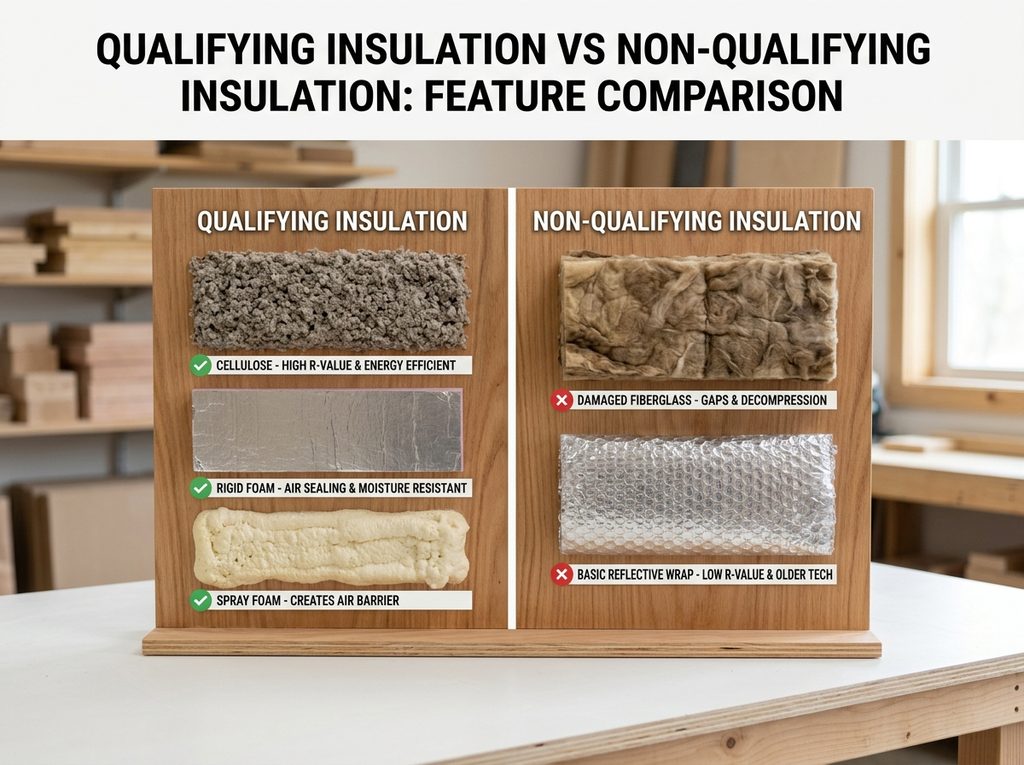
| Feature | Qualifying Insulation | Non-Qualifying Insulation |
|---|---|---|
| Tax Credit Eligibility | 30% federal tax credit (Inflation Reduction Act) | No federal tax credit for insulation material |
| Annual Credit Cap | Up to $1,200 combined with other envelope upgrades | $0—not applicable |
| R-Value Requirement | Meets IECC building code R-value standards | Below code-minimum R-value |
| Certification Needed | ENERGY STAR or manufacturer certification statement | No certification on file |
| Installation Labor Cost | Excluded from credit (materials only) | Not applicable |
| Documentation | Receipts, Manufacturer’s Certification Statement | Missing or incomplete records |
| Filing Form | IRS Form 5695, Part II | Not filed—ineligible |
| Home Type | Existing primary residence in the U.S. | New construction or rental-only properties |
What Type of Insulation Qualifies for Energy Tax Credit?
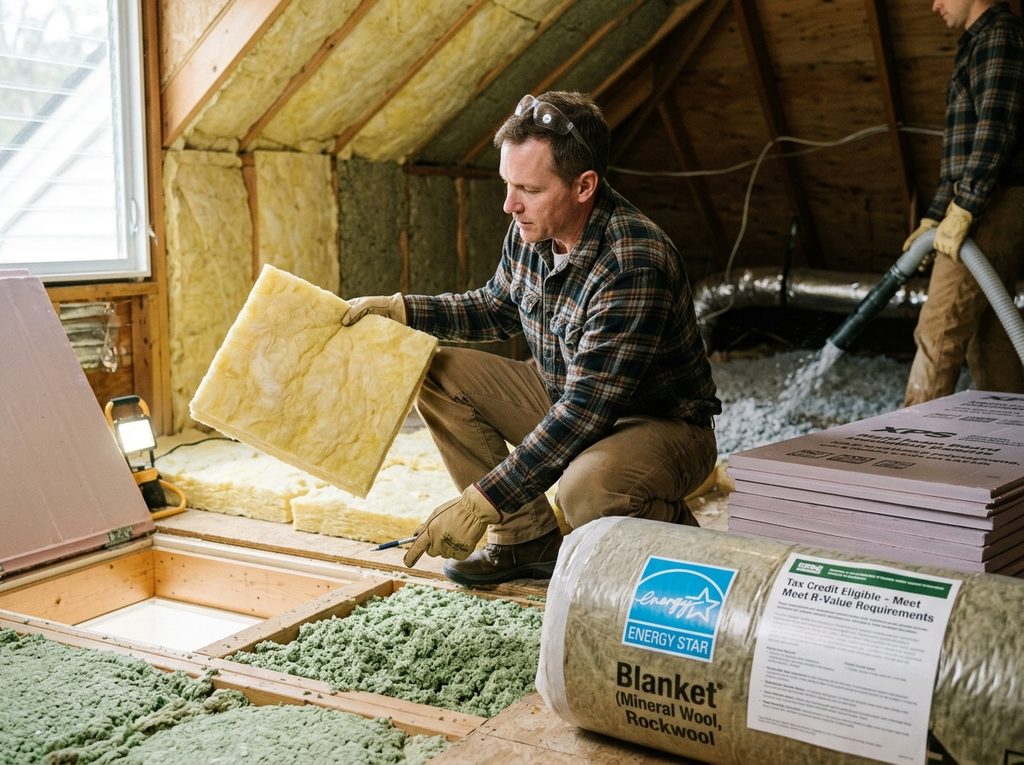
Attic insulation, fiberglass insulation, cellulose insulation, and spray foam insulation all qualify for the Energy Efficient Home Improvement Credit when they meet IECC building code R-value requirements. According to the IRS (2023), qualifying materials must primarily reduce heat loss or gain in the building envelope.
Unlike decorative or structural insulation, qualified energy efficiency improvements must be installed in an existing home—not new construction. This distinction matters: new-build insulation typically falls under separate builder tax incentives, not the Residential Energy Credits claimed by homeowners.
Is Attic Insulation Tax Deductible in 2023 and Beyond?
Attic insulation remains tax deductible through 2032 under the Inflation Reduction Act, provided it meets ENERGY STAR insulation standards. This 10-year window replaced the prior $500 lifetime cap with an annual $1,200 limit, resetting every tax year.
How Much Is the Insulation Tax Credit Worth Compared to Rebate Programs?
The federal insulation incentive covers 30% of material costs, whereas state energy programs and insulation rebate programs often provide fixed dollar amounts regardless of project size. For example, a $4,000 insulation upgrade could yield a $1,200 federal tax credit, in contrast to a flat $500 utility rebate.
Homeowners can typically stack both: claim the federal insulation incentive on Form 5695 and apply for local insulation rebate programs separately, maximizing total home insulation cost savings.
Insulation Tax Credit vs Rebate Program: What’s the Difference?
- Tax credit: Reduces tax liability dollar-for-dollar; claimed during tax filing.
- Rebate: Provides upfront or mail-in cash back, independent of tax filing.
- Tax credit: Requires IRS Form 5695 and proof of qualified energy efficiency improvements.
- Rebate: Requires separate application through utility or state energy programs.
How to Fill Out Form 5695 for Insulation Tax Credit Documentation
To claim the insulation tax credit on taxes, homeowners must complete IRS Form 5695, Part II, and attach it to their federal tax filing. Required documentation for insulation tax credit claims includes:
- Itemized contractor invoice separating material and labor costs
- Manufacturer’s Certification Statement confirming ENERGY STAR insulation compliance
- Proof of installation date within the applicable tax year
- Home energy audit report, if used to identify insulation upgrade needs
For deeper guidance on documentation and eligibility, homeowners can consult resources on insulation energy tax credit requirements before starting a project.
Contractor Certification vs DIY Insulation: Does It Affect Tax Credit Eligibility?
The IRS does not require contractor certification for insulation material purchases, unlike some HVAC-related credits. However, professional installation ensures proper R-value achievement and building envelope sealing, which supports weatherization tax credit claims during an audit.
Use-Case Scenarios: When Does Insulation Qualify?
Scenario 1: Attic Insulation Upgrade
A homeowner replaces old attic insulation with cellulose insulation meeting IECC standards. Cost: $3,500. Result: $1,050 federal tax credit (30%), well under the $1,200 cap.
Scenario 2: Spray Foam Insulation Installation
Spray foam insulation costing $5,000 qualifies if it meets ENERGY STAR insulation criteria. The credit caps at $1,200, so the homeowner receives the maximum allowed, not the full 30% of $5,000.
Scenario 3: DIY Fiberglass Insulation Install
A homeowner self-installs fiberglass insulation and buys materials for $1,200. Because labor isn’t required for material-only credits, the $360 tax credit applies to material costs alone.
Scenario 4: Combining Federal Credit with State Rebate
A homeowner in a state offering insulation rebate programs receives a $400 rebate plus a 30% federal tax credit on remaining costs—maximizing green home tax incentives without double-dipping on the same expense category.
Decision Framework: Which Insulation Path Should You Choose?
- Choose qualifying insulation upgrades if: You want federal tax credit eligibility, plan to itemize on Form 5695, and use ENERGY STAR-certified materials.
- Choose non-qualifying or new-construction insulation if: You’re building a new home (separate incentives apply) or installing insulation below code-minimum R-value for non-primary structures.
- Choose to combine credit and rebate if: Your state offers weatherization credit programs alongside federal incentives.
According to the U.S. Department of Energy (2023), insulation upgrades remain among the most cost-effective energy efficient home upgrades, often paying for themselves within 3–5 years through reduced utility bills.