
Serving Great Indy Area: Indianapolis, Brownsburg, Zionsville, Carmel, Fishers, Westfield, Noblesville, and Whitestown
Why blown-in insulation?
Loose-fill fiberglass or cellulose spreads uniformly over joists and around obstructions.
When combined with proper air sealing and ventilation, blown-in performs at its best.
Fast to install, excellent for top-offs in existing attics.
Fewer hot/cold spots, better temperature hold, and a quieter home.
Tip: Most Indianapolis-area homes benefit from an attic R-value in the R-38 to R-49 range. We’ll audit current levels and recommend an upgrade path tailored to your home.
What to Expect (Our Process)
01
Free in-home assessment
We measure current depth, check ventilation, and identify air-leak pathways around can lights, chases, and attic hatches
02
Customized plan
Material (fiberglass or cellulose), target R-value, and any prep (air sealing, baffles, damming).
03
Same-day installation (most homes)
Depth markers, ruler photos, and a quick walkthrough so you see exactly what changed.
04
Quality check
We ensure soffits and ridge vents remain functional so airflow is balanced.
05
Post-install guidance
Tips to keep the attic dry and efficient (soffit clearances, bath fan terminations, etc.).
Local Use Cases
Add-Ons That Multiply Result
Air sealing
Close the gaps first so insulation can actually perform.
Baffles & ventilation tune-up
Keeps soffits breathing and insulation dry.
Attic hatch & can-light covers
Address the biggest leakage points.
Radiant barrier or attic fans (case-by-case)
For south-facing, sun-loaded roofs, these can further reduce attic temps and support system performance.
Materials We Install
We’ll recommend the best option after your audit; both deliver excellent results when installed to spec.
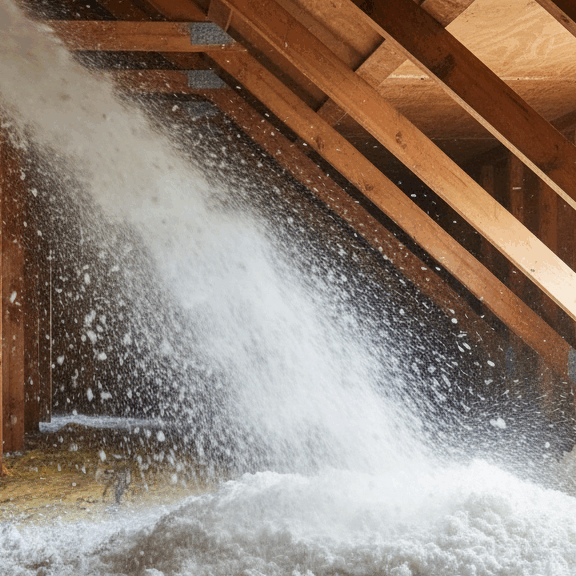
How Blown-In Insulation Works
Our crews use a calibrated blower machine to break apart fiberglass or cellulose material and feed it through a hose into your attic at a controlled density. It's not a rough guess, but a rate matched to the manufacturer's spec for the R-value we're installing to. That's what lets us fill in tight around joists, wiring, plumbing stacks, and other obstructions without leaving gaps behind.
Why density matters
A lot of attics look "full" but were never installed to the right density: too loose, and it settles and underperforms within a few years; too dense, and you've paid for material you didn't need. We check both depth and density on every job, which is part of why our installs hold their R-value longer than a rushed top-off.
Attic vs. wall application
We install blown-in as loose-fill in attics, spread across the attic floor. If your project is a wall cavity instead, our crews handle that differently, as dense-pack, blown in under pressure through small access holes (see our dense-pack wall insulation page for wall-specific jobs). We'll tell you upfront which approach your home actually needs.
How long it lasts
Fiberglass holds its R-value for the life of the home when installed correctly and kept dry, so we rarely see it need attention. Cellulose can settle 15–20% over many years, which is why, during your assessment, we specifically check attics insulated a decade or more ago; that's usually where a top-off makes the biggest difference.
More Indianapolis Metro Areas We Serve
Neighborhoods we regularly serve: Meridian-Kessler, Broad Ripple, and Irvington (Indianapolis area). Don't see your neighborhood listed? We serve the entire Indianapolis Metro Area. Contact us, and we'll confirm coverage for your address.
What Happens On Installation Day
Before we start
We walk the attic access point with you, lay down floor protection along the path to the attic, and confirm the target R-value and material discussed in your assessment.
During installation
The blower machine stays outside or in the garage — only the hose enters the attic — to keep noise and mess out of your living space. We install to the calibrated depth for your target R-value.
Cleanup & walkthrough
We clean the work path, remove equipment, and walk you through the attic with depth-marker photos so you can see the new coverage before we leave.
After installation
Most homeowners notice fewer temperature swings between floors within the first few heating or cooling cycles.