
Spray foam insulation is an expanding polyurethane foam material applied as a liquid that creates an air-tight thermal barrier. Blown-in insulation consists of loose-fill cellulose or fiberglass materials pneumatically installed into wall cavities and attics. Batt insulation comprises pre-cut fiberglass or mineral wool blankets fitted between studs and joists. According to the Department of Energy (2024), selecting the appropriate insulation material significantly impacts heating and cooling costs and overall energy consumption reduction.
These three primary insulation types dominate the residential insulation market as of 2025. Understanding their distinct characteristics, thermal performance, and best applications enables homeowners to make informed decisions about building envelope improvements. Each insulation method offers unique advantages for thermal resistance, air sealing, and moisture control depending on installation location and climate conditions.
Key Characteristics of Spray Foam, Blown-In, and Batt Insulation
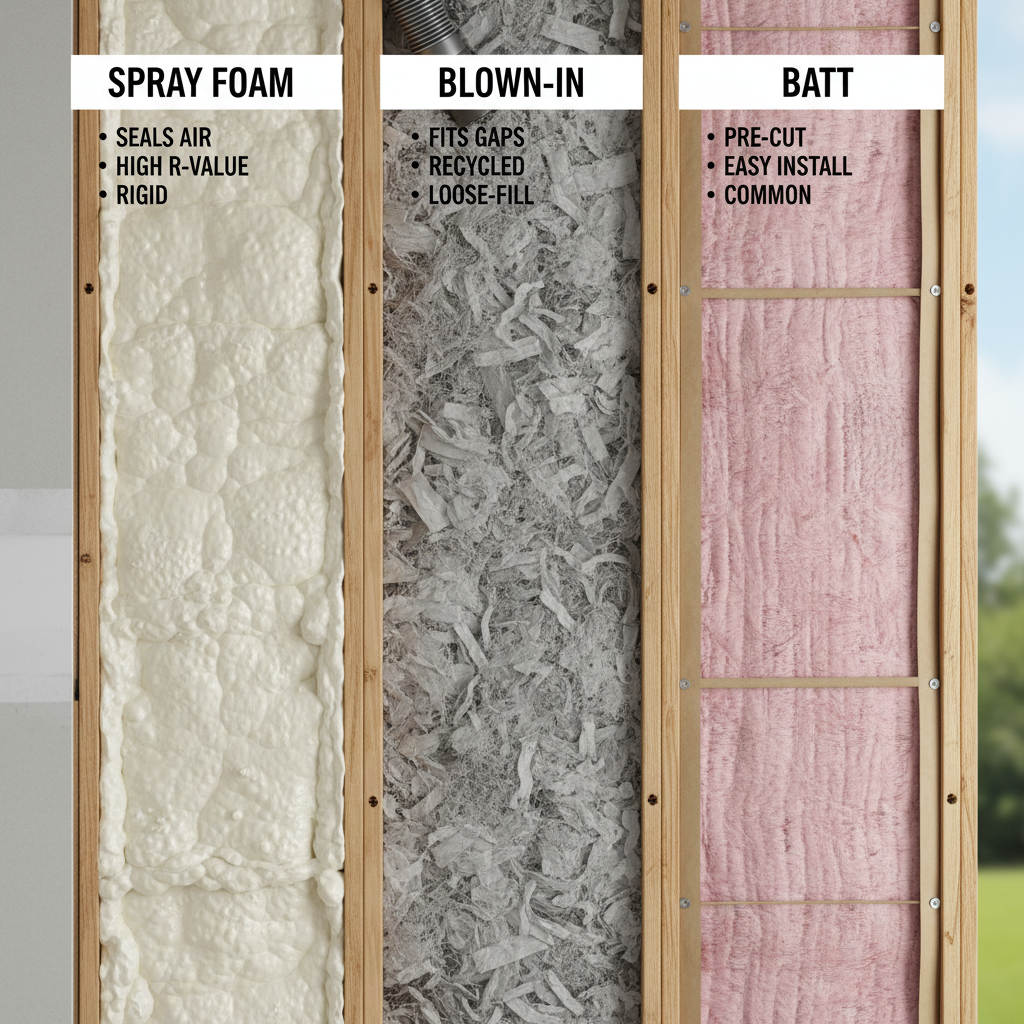
The fundamental differences between these insulation materials extend beyond composition to include installation methods, thermal conductivity, and functional properties.
Spray Foam Insulation Properties
Spray polyurethane foam (SPF) exists in two primary formulations: closed-cell spray foam and open-cell spray foam. Closed-cell foam, also called two-pound foam due to its density, delivers R-6.5 to R-7 per inch of insulation thickness. This high-density foam provides superior thermal resistance compared to other insulation options. Open-cell foam, known as half-pound foam, offers R-3.5 to R-4 per inch but requires greater insulation thickness for equivalent performance.
Spray foam insulation creates exceptional air sealing benefits by expanding to fill gaps, cracks, and irregular spaces within the building envelope. Unlike other insulation types, closed-cell spray foam functions as both a thermal barrier and vapor barrier, preventing air infiltration and moisture penetration. The material adheres directly to roof deck, drywall, and structural components, eliminating thermal bridging at studs and joists.
Blown-In Insulation Characteristics
Loose-fill insulation includes cellulose vs fiberglass blown-in insulation materials, each offering distinct properties. Loose-fill cellulose consists of recycled paper products treated with fire-resistant chemicals, making it an eco-friendly insulation choice. This insulation material achieves R-3.2 to R-3.8 per inch when properly installed.
Blown-in fiberglass delivers R-2.2 to R-2.7 per inch of insulation coverage. The pneumatic installation process allows complete insulation of irregular spaces, attic floor areas, and existing wall cavity insulation without removing drywall. Dense pack insulation, a specialized blown-in technique, achieves insulation density comparison values of 3.5 pounds per cubic foot in wall dense pack applications, providing enhanced thermal efficiency and soundproofing insulation benefits.
Batt Insulation Features
Fiberglass batts and rockwool batts represent the most common insulation blankets available in pre-cut dimensions matching standard stud spacing. Fiberglass batt insulation provides R-3.1 to R-3.4 per inch, while mineral wool (rock wool) delivers R-3.3 to R-4.2 per inch. These insulation rolls come in faced insulation (kraft-faced batts with vapor retarder) or unfaced insulation configurations.
Batt insulation represents the easiest insulation to install yourself for DIY-capable homeowners. The pre-cut batts fit between wall studs, ceiling joists, and floor joists without specialized equipment. However, proper installation requires careful attention to avoid compression, gaps, and incomplete coverage that reduce effective insulation performance.
How Each Insulation Type Works
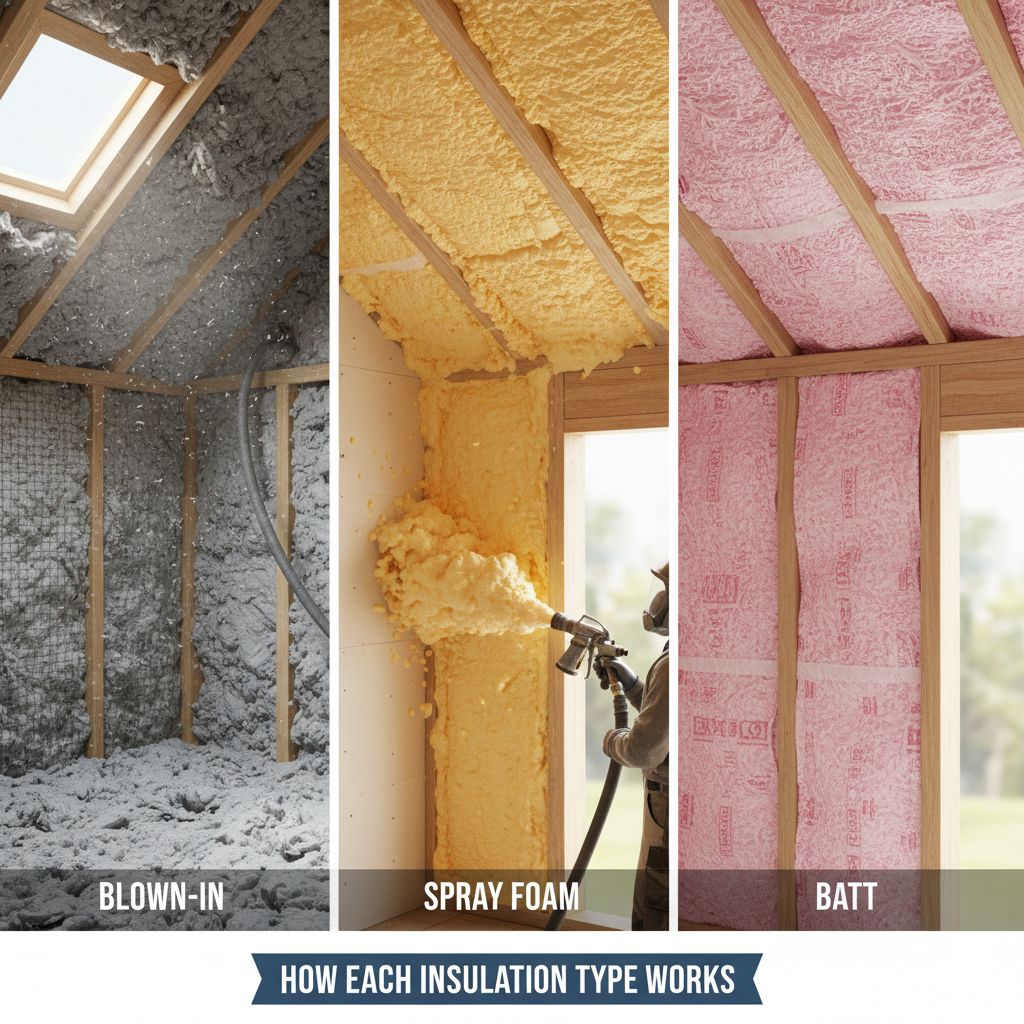
Spray Foam Insulation Installation Process
Professional installation required for spray foam necessitates specialized equipment and training. The spray foam insulation installation process follows these steps:
- Surface preparation removing debris and moisture from application areas
- Mixing two-component polyurethane foam chemicals at precise ratios
- Applying foam in controlled passes to achieve specified insulation thickness
- Allowing 24-hour curing period before covering with drywall or other materials
- Trimming excess foam flush with framing members
The expanding foam fills rim joist, band joist, and sill plate areas completely, creating continuous thermal and air barriers. This spray foam vs fiberglass advantage significantly reduces heat retention losses and air infiltration compared to traditional methods.
Blown-In Insulation Installation Process
Can I install blown-in insulation myself? While possible, the blown-in insulation installation process typically requires equipment rental and two-person operation:
- Setting up pneumatic blowing machine loaded with cellulose or fiberglass material
- Calculating required insulation coverage depth for target R-value
- Installing depth markers or rulers throughout attic space
- Blowing insulation material evenly across attic floor or into wall cavities
- Ensuring consistent insulation density comparison throughout application area
Wet spray cellulose applications include moisture addition for stabilized cellulose that resists settling in wall applications. Dry blown cellulose works effectively for attic blown insulation where settling presents minimal concern.
Batt Insulation Installation Tips
How to install batt insulation in walls requires attention to detail for optimal thermal performance:
- Measuring wall cavity dimensions and cutting batts to exact fit
- Placing batts between studs without compression or gaps
- Splitting batts around electrical wiring and outlet boxes
- Installing vapor barrier (kraft facing) toward heated living space
- Securing batts with friction fit or fasteners as needed
Best DIY insulation option for homeowners typically involves unfaced fiberglass batts in accessible attic spaces where installation errors cause less performance degradation than in wall applications.
Performance Comparison: R-Value, Cost, and Effectiveness
| Insulation Type | R-Value Per Inch | Cost Per Square Foot (2025) | Air Sealing Rating | Moisture Resistance |
|---|---|---|---|---|
| Closed-Cell Spray Foam | R-6.5 to R-7 | $1.50-$3.00 | Excellent | Excellent (vapor barrier) |
| Open-Cell Spray Foam | R-3.5 to R-4 | $0.75-$1.50 | Excellent | Moderate (requires separate vapor barrier) |
| Blown-In Cellulose | R-3.2 to R-3.8 | $0.40-$0.80 | Good (dense pack) | Good (naturally moisture resistant) |
| Blown-In Fiberglass | R-2.2 to R-2.7 | $0.35-$0.70 | Moderate | Poor (absorbs moisture) |
| Fiberglass Batts | R-3.1 to R-3.4 | $0.30-$0.60 | Poor (gaps common) | Poor (absorbs moisture) |
| Mineral Wool Batts | R-3.3 to R-4.2 | $0.60-$1.20 | Moderate | Excellent (hydrophobic) |
Which insulation has highest R-value per inch? Closed-cell spray foam delivers superior thermal resistance per inch of insulation thickness, reducing required space in wall cavities while maximizing energy efficiency. However, cost comparison spray foam vs blown-in insulation reveals 3-5 times higher material and installation expenses for spray foam applications.
Most cost-effective insulation for attic applications typically involves blown-in cellulose due to favorable insulation cost comparison, ease of installation in irregular spaces, and adequate thermal performance for horizontal applications. The insulation payback period for cellulose averages 2-4 years through energy saving insulation benefits.
Common Misconceptions About Insulation Types
Myth: All Insulation Provides Equal Energy Efficiency
Reality: Thermal efficiency depends on both R-value and air sealing capabilities. According to building codes enforcement data (2024), homes insulated with spray foam insulation show 25-40% less air infiltration compared to batt insulation installations. Which insulation provides best air sealing? Spray foam creates continuous air barriers that eliminate convective heat loss, making it most energy-efficient insulation type despite lower R-values than some alternatives in specific applications.
Myth: Spray Foam Insulation Always Provides Best Return on Investment
Reality: Is spray foam insulation worth the cost? Return on investment calculations depend on climate conditions, existing insulation levels, and utility rates. In cold climate insulation applications where air sealing significantly impacts heating costs, spray foam delivers superior insulation payback period of 5-8 years. However, warm climate insulation projects with adequate existing coverage may not justify premium spray foam insulation cost.
Myth: Batt Insulation Performance Equals Blown-In Insulation
Reality: Is blown-in insulation better than batts? Field studies demonstrate that batt insulation achieves only 80-90% of rated R-value due to compression, gaps, and thermal bridging at framing members. Blown-in insulation conforms completely to irregular spaces, delivering 95-100% of rated thermal performance in proper installations. The insulation density comparison favors dense pack cellulose in retrofit wall applications where removing drywall is impractical.
Myth: Higher R-Value Always Means Better Insulation
Reality: Effective insulation considers air sealing, moisture control, and thermal bridging alongside R-value comparison. For example, R-30 fiberglass batts with 10% air gaps perform worse than R-25 spray foam with complete air sealing. Building insulation solutions require integrated approaches addressing the entire building envelope rather than focusing solely on insulation material R-values.
Practical Applications: Best Uses for Each Insulation Type
Best Insulation for Attics: Spray Foam or Blown-In?
Best insulation for attic spray foam or blown-in depends on roof design and ventilation requirements. Attic floor insulation benefits from blown-in cellulose or fiberglass, providing cost-effective coverage over irregular joist spacing. This approach maintains attic ventilation for moisture control and heat dissipation. Alternatively, spray foam applied directly to roof deck creates conditioned attic space, eliminating ductwork insulation needs and protecting HVAC system components from temperature extremes.
Most cost-effective insulation for attic applications involves loose-fill cellulose achieving R-38 to R-60 values in northern climates, with installation costs 60-70% lower than equivalent spray foam coverage. Companies like Homeward Insulation specialize in evaluating specific project requirements to recommend optimal insulation solutions.
Best Insulation for Walls: Batt or Spray Foam?
Best insulation for walls batt or spray foam decisions balance performance against budget constraints. New construction benefits from spray foam insulation advantages and disadvantages analysis: superior air sealing and moisture barrier properties justify higher costs in premium construction. The continuous thermal barrier eliminates thermal bridging at studs, reducing wall cavity insulation heat transfer by 15-25% compared to batt installations.
Best type of insulation for old houses often involves blown-in cellulose for existing wall retrofit projects. Dense pack insulation achieves R-13 to R-15 in standard 2×4 walls through small access holes, avoiding extensive drywall removal. This insulation retrofitting approach costs $1.50-$3.00 per square foot versus $4-$7 for spray foam requiring wall cavity exposure.
Basement Insulation and Crawl Space Applications
Foundation insulation and basement insulation require moisture resistant insulation materials resistant to condensation and water intrusion. Closed-cell spray foam excels in crawlspace insulation applications, adhering directly to foundation walls and rim joist areas while serving as vapor barrier. The moisture control properties prevent mold growth and structural damage in below-grade applications.
Mineral wool batts offer alternative basement insulation options combining fire resistance, sound insulation, and moisture tolerance. Unlike fiberglass insulation, rockwool maintains thermal performance when exposed to humidity, making it suitable for basement applications with proper vapor retarder installation.
Specialty Applications: Pipe Insulation and Ductwork Insulation
Pipe insulation and ductwork insulation in unconditioned spaces prevent energy losses and condensation issues. Spray foam provides complete coverage around complex duct configurations and irregular pipe runs. However, foam board and insulation board products offer cost-effective rigid foam insulation for accessible straight runs. Reflective insulation and radiant barrier products enhance thermal performance in hot climates by reducing radiant heat transfer to ductwork and piping.
Selecting Between Spray Foam, Blown-In, and Batt Insulation
How to choose between spray foam and batt insulation requires evaluating multiple factors:
Budget Considerations: Cost comparison batt vs spray foam insulation shows batt materials cost 50-70% less than open-cell spray foam and 75-85% less than closed-cell foam. How much does spray foam insulation cost ranges from $1,500-$5,000 for typical attic applications versus $500-$1,500 for blown-in cellulose coverage achieving equivalent R-value.
Performance Priorities: Should I use spray foam or blown-in insulation depends on whether air sealing or cost-effectiveness drives project goals. Homes in extreme climates benefit from spray foam insulation advantages despite premium pricing. Moderate climate zones achieve adequate thermal performance through properly installed blown-in or batt products at substantially lower insulation installation cost.
Installation Requirements: Best insulation for new construction allows spray foam integration during framing before drywall installation. Existing home insulation replacement projects favor blown-in materials avoiding destructive wall cavity access. DIY capabilities influence insulation options, as batt installation requires minimal equipment while blown-in and spray foam necessitate specialized tools or professional contractors.
Longevity Expectations: How long does spray foam insulation last exceeds 80 years with no insulation degradation when properly installed. How long does blown-in insulation last ranges from 20-30 years for cellulose before settling reduces thermal performance. How long does batt insulation last extends 50+ years if protected from moisture and compression, though improper installation compromises effectiveness immediately.
The best type of insulation for specific applications balances these factors against building codes, climate requirements, and energy efficiency goals. Consulting insulation contractors ensures code compliance and optimal building insulation solutions for residential insulation and commercial insulation projects as of 2025.