
R-value is a measurement of thermal resistance that indicates how effectively insulation materials resist heat flow through walls, attics, and crawl spaces. In Indiana, proper R-value selection directly impacts heating costs, cooling costs, and overall home energy efficiency throughout the state’s variable climate conditions.
Why R-Value Requirements Matter in Indiana’s Climate
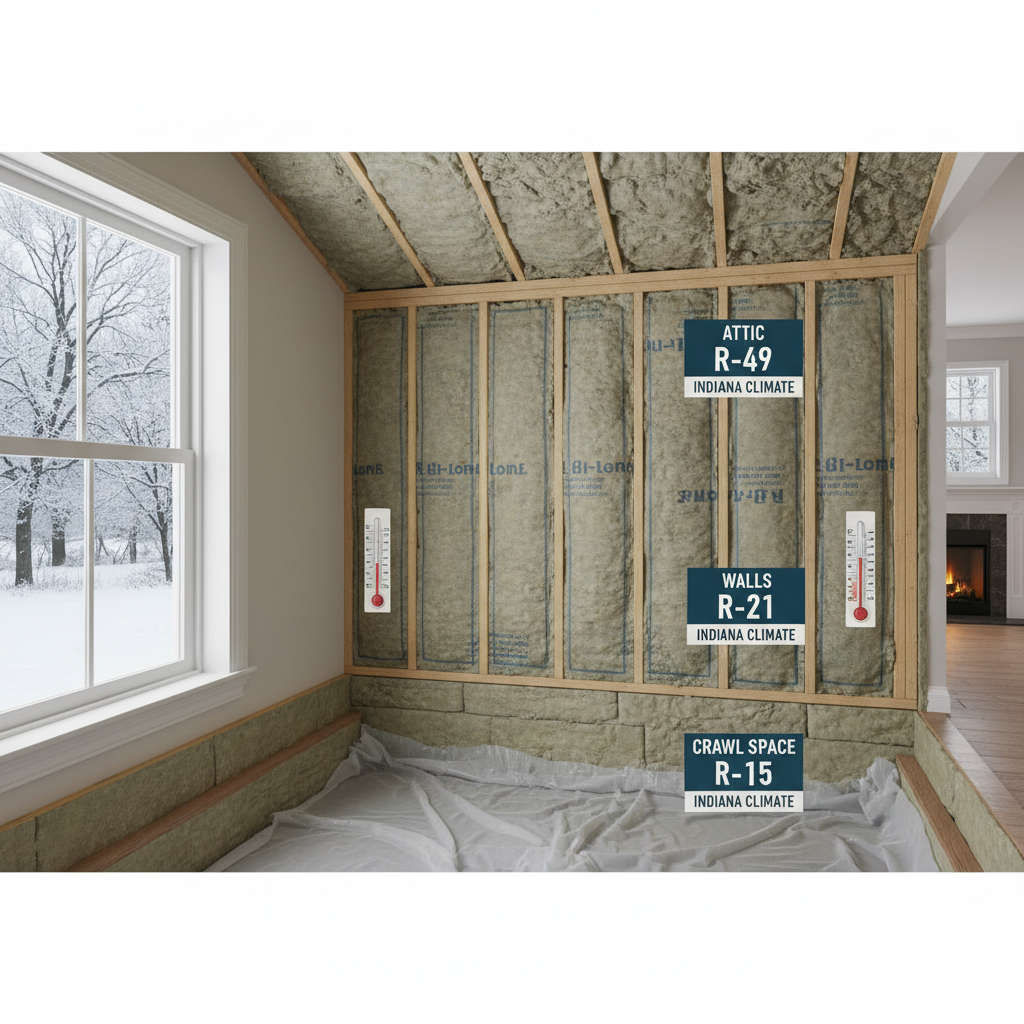
Indiana falls primarily within Climate Zone 5, with southern portions classified as Climate Zone 4 according to the International Energy Conservation Code (IECC). These climate zone insulation requirements reflect the state’s cold winters and humid summers, where inadequate thermal resistance values result in significant heat loss prevention failures and elevated utility bills.
The Department of Energy (DOE) establishes recommended R-values based on regional climate data and cost-effective insulation analysis. For Indiana homeowners, meeting these insulation requirements Indiana standards reduces energy conservation challenges by minimizing conductive heat loss, convective heat loss, and radiant heat transfer through the building envelope.
According to Energy Star recommendations updated in 2024, properly insulated homes in Indiana can reduce heating and cooling efficiency costs by 15-20% annually compared to homes with minimum insulation requirements.
Key Characteristics of R-Value Measurement
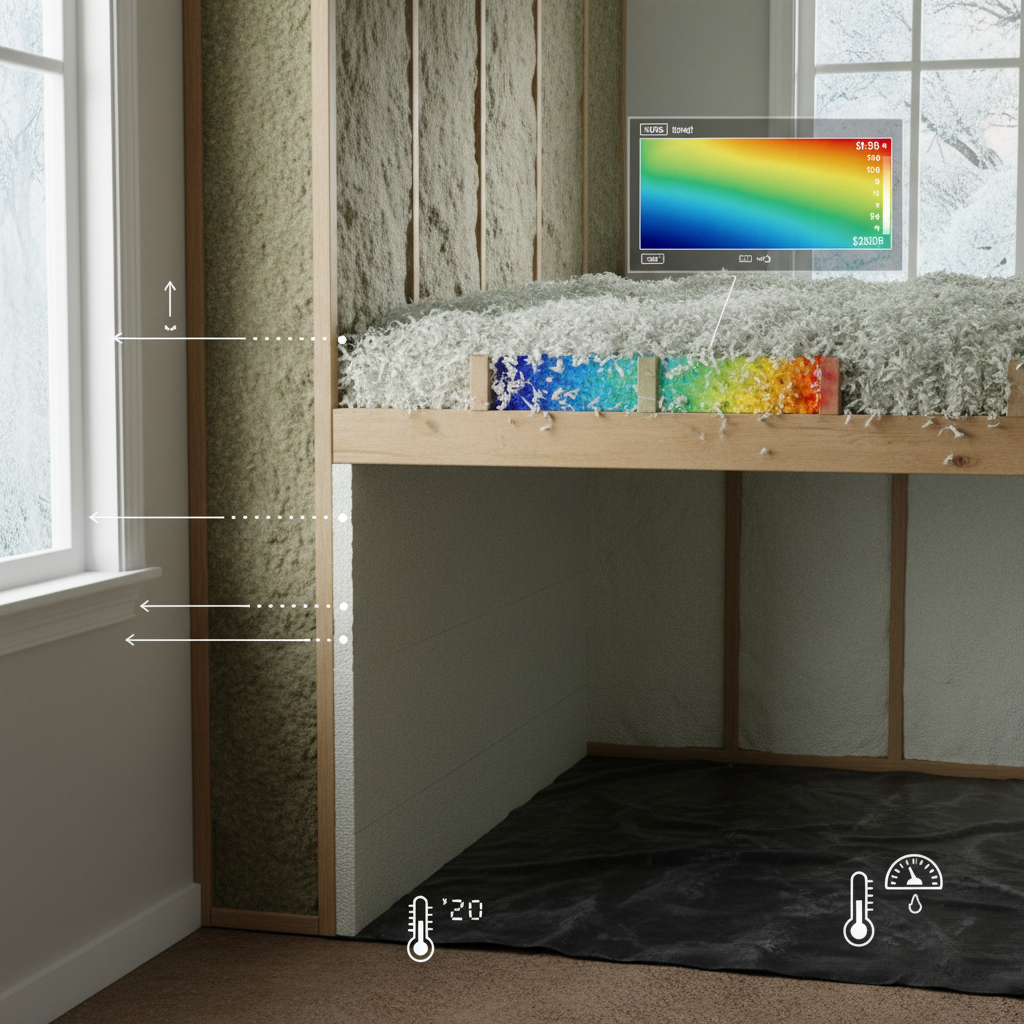
Understanding building thermal performance requires recognizing five essential characteristics of thermal resistance:
- Additive Property: R-values combine when insulation layers stack together. R-13 batt insulation plus R-5 rigid foam boards creates R-18 total thermal resistance.
- Material Specificity: R-value per inch varies significantly between fiberglass insulation (R-2.2 to R-2.7), cellulose insulation (R-3.2 to R-3.8), and spray foam insulation (R-3.5 to R-6.5 per inch).
- Temperature Independence: Nominal R-value ratings assume standard testing conditions at 75°F mean temperature.
- Installation Sensitivity: Compressed insulation and settled insulation reduce effective R-value by 20-50% below manufacturer specifications.
- Whole-System Context: Whole wall R-value accounts for thermal bridging through studs, reducing cavity insulation effectiveness by approximately 25%.
Indiana R-Value Requirements by Home Location
Attic Insulation Requirements: R-49 to R-60 Standards
The recommended R-value for attic insulation in Indiana ranges from R-49 to R-60 for unfinished attic spaces. These attic insulation requirements reflect the critical role of attic space in preventing winter heat escape and summer heat gain.
For blown-in insulation using fiberglass or cellulose materials, achieving R-49 requires approximately 16-19 inches of insulation depth, while R-60 demands 20-24 inches depending on material density. According to DOE insulation guidelines published in 2024, upgrading from R-19 to R-49 attic insulation in Indiana climate conditions delivers payback periods of 3-5 years through reduced utility cost reduction.
Finished attic insulation requirements Indiana standards specify R-38 minimum for cathedral ceiling applications where rafter depth limits insulation thickness. Knee wall insulation R-value should match exterior wall standards at R-21 minimum.
Wall Insulation Standards: R-13 to R-21 Requirements
Minimum R-value for walls in Indiana homes depends on wall cavity dimensions and construction type. Standard 2×4 walls accommodate R-13 to R-15 cavity insulation, while 2×6 walls support R-19 to R-21 insulation levels.
The International Energy Conservation Code mandates R-20 for Climate Zone 5 exterior wall assemblies when accounting for continuous insulation methods. This whole wall R-value approach recognizes thermal mass and air sealing techniques as complementary factors beyond cavity insulation alone.
Interior walls typically receive R-0 insulation in conditioned spaces, though acoustic insulation may employ R-13 for sound dampening. Basement wall insulation R-value requirements specify R-15 minimum for conditioned basement spaces in Indiana building code compliance scenarios.
Crawl Space Insulation Guide: R-19 to R-30 Specifications
Crawl space insulation R-value requirements Indiana standards distinguish between vented and unvented configurations. Vented crawl space approaches insulate floor joists above the crawl space with R-19 minimum, while crawl space encapsulation methods apply R-10 to R-15 continuous insulation to foundation walls.
The rim joist insulation requirements Indiana code specifies R-10 minimum using rigid foam insulation or spray foam materials to address this significant thermal bypass location. According to building science research from 2023, rim joist air sealing combined with proper insulation R-value eliminates 8-12% of whole-house heat transfer.
Ground moisture barrier installation using 6-mil polyethylene vapor barrier complements insulation performance by preventing condensation and enabling moisture control strategies essential for mold prevention.
How R-Value Works: Understanding Heat Transfer Mechanisms
Thermal resistance values quantify insulation’s ability to impede three heat transfer modes:
- Conduction: Direct molecular heat movement through solid materials, measured by thermal conductivity coefficients. Lower thermal conductivity indicates higher R-value effectiveness.
- Convection: Heat transfer via air movement within and around insulation. Air sealing importance increases because air infiltration reduction prevents convective heat loss bypassing insulation.
- Radiation: Electromagnetic heat transfer addressed by reflective insulation facing materials that reduce radiant heat transfer by 90% when facing air spaces.
The relationship between R-value and U-value (thermal transmittance) follows the formula U = 1/R. A wall assembly with R-20 total resistance exhibits U-0.05, meaning 0.05 BTU per hour transfers through each square foot per degree Fahrenheit temperature difference.
Common R-Value Misconceptions: Myth vs. Reality
Myth: Higher R-value always provides better performance regardless of installation quality.
Reality: Insulation gaps covering just 5% of wall area reduce effective R-value by 25-40%. Proper ventilation, complete insulation coverage, and draft prevention prove equally critical for thermal performance standards.
Myth: R-value remains constant after installation.
Reality: Settled insulation in attics can lose 10-20% of initial R-value within 5-10 years. Blown-in insulation requires periodic inspection to maintain nominal R-value ratings.
Myth: Vapor barrier installation always prevents moisture problems.
Reality: Incorrect vapor retarder placement creates moisture control failures. In Indiana’s climate, faced insulation should position vapor barriers toward heated spaces during heating-dominant seasons.
Myth: Maximum R-value provides unlimited energy savings.
Reality: Cost-effective insulation analysis shows diminishing returns beyond recommended insulation levels. Optimal insulation levels balance upfront costs against seasonal efficiency improvements over 20-30 year periods.
R-Value vs. U-Value: Understanding Key Differences
While R-value measures thermal resistance, U-value quantifies thermal transmittance—the rate of heat flow through building materials. These reciprocal measurements serve different purposes in building envelope efficiency assessment.
R-value applies to individual insulation layers and components, making it useful for insulation material comparison and installation planning. U-value describes complete assembly performance including all layers, air films, and thermal bridging effects.
Energy code compliance increasingly references U-value for fenestration (windows and doors) while maintaining R-value standards for opaque assemblies like walls and attics. A window with U-0.30 permits three times more heat transfer than a wall section with U-0.10, illustrating why comprehensive insulation addresses whole-house thermal envelope performance.
Practical Applications: Material Selection and Installation
Insulation Material Comparison for Indiana Homes
Best insulation for attics in Indiana typically involves blown-in fiberglass or cellulose achieving R-49 to R-60. Cellulose insulation provides superior air sealing techniques by conforming to irregular spaces, while fiberglass offers lower material costs at R-2.5 per inch versus cellulose’s R-3.5 per inch.
Best insulation for walls depends on cavity dimensions. Standard 2×4 construction accommodates R-13 to R-15 batt insulation or R-15 spray foam. The 2×6 wall construction enables R-19 to R-21 fiberglass batts or R-21 dense-pack cellulose installation.
Best insulation for crawl spaces in unvented configurations employs closed-cell spray foam insulation at R-10 minimum on foundation walls, combined with R-10 rigid foam boards on ground surfaces. Vented crawl space approaches use unfaced fiberglass batts between floor joists at R-19 minimum.
Installation Tips for Effective R-Value Achievement
Achieving effective insulation R-value requires attention to installation details beyond material selection:
- Attic Ventilation Ratio: Maintain 1:150 ventilation ratio (1 sq ft vent per 150 sq ft attic) using soffit vents and ridge vents to prevent moisture accumulation while preserving insulation performance.
- Air Sealing Priority: Complete air sealing before insulation installation. Blower door testing identifies air infiltration sources requiring caulk or spray foam treatment.
- Proper Installation Techniques: Split batts around wiring and avoid compression. Maintain manufacturer-specified density for blown-in applications.
- Thermal Imaging Verification: Post-installation thermal imaging inspection reveals insulation gaps and thermal bypass locations invisible to visual inspection.
Professional Assessment and Compliance Verification
Home energy audit services from qualified insulation contractors provide comprehensive insulation assessment using blower door test protocols and infrared thermal imaging technology. These home performance assessment procedures identify retrofit insulation guide priorities and verify Indiana residential insulation requirements 2024 compliance.
Homeward Insulation offers professional insulation services including material specification, installation oversight, and energy audit recommendations tailored to Indiana’s climate zone requirements and existing home insulation conditions.
Implementing R-Value Requirements: Next Steps for Indiana Homeowners
Meeting recommended insulation levels requires systematic evaluation of current conditions against Indiana building code R-value requirements. New home insulation should incorporate continuous insulation strategies and advanced air sealing importance from initial construction phases.
Existing home insulation upgrades benefit from prioritized approaches: attic insulation typically offers fastest payback, followed by basement and crawl space treatments, then wall insulation retrofit when accessible during renovation projects.
Temperature regulation improvements become noticeable within the first heating season after proper insulation upgrade completion. Indoor comfort enhancements include reduced temperature stratification, eliminated cold surfaces, and consistent HVAC system performance throughout conditioned spaces.
Understanding insulation R-value chart data, material options, and installation requirements empowers Indiana homeowners to make informed decisions about thermal envelope efficiency investments that deliver utility cost reduction and enhanced comfort for decades.