
For Indiana homes, closed-cell spray foam insulation provides superior moisture control and air sealing with R-6.5 to R-7 per inch, whereas blown-in cellulose insulation offers cost-effective thermal resistance at R-3.2 to R-3.8 per inch with lower upfront installation expenses. According to the Department of Energy, spray foam creates an integrated air barrier and vapor barrier, making it ideal for basements and crawl spaces in humid Indiana summers, while blown-in insulation excels in attic applications where air sealing is handled separately.
Spray Foam vs Blown-In Insulation: Complete Feature Comparison
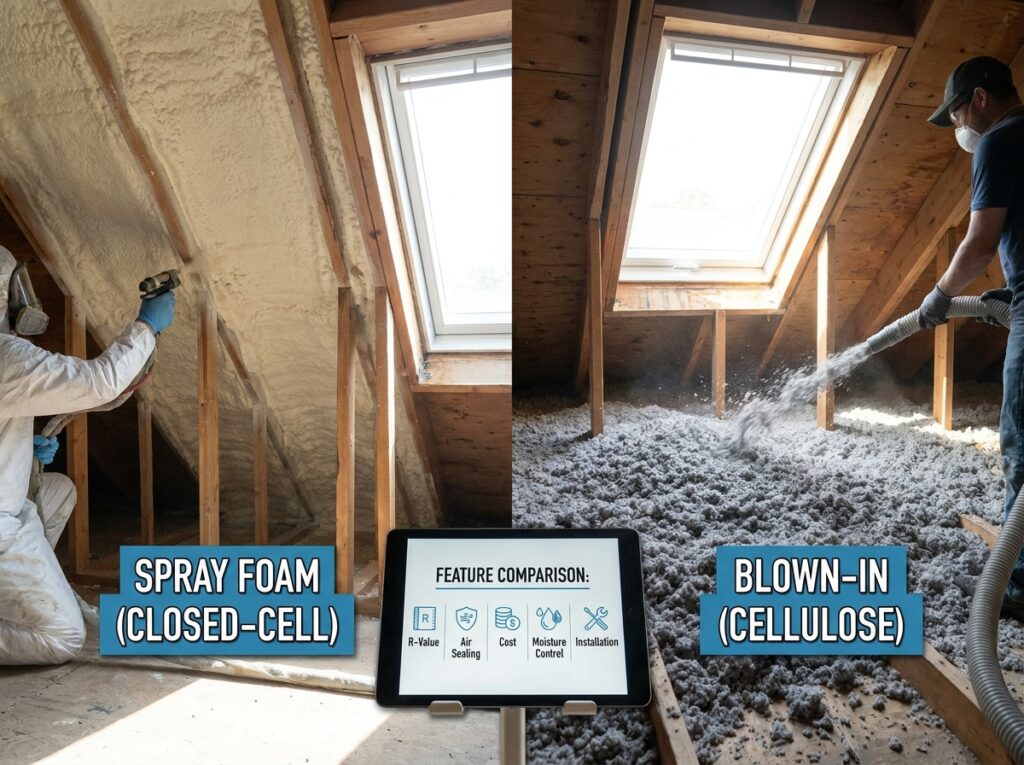
| Feature | Spray Foam Insulation | Blown-In Insulation |
|---|---|---|
| R-Value Per Inch | Open-cell: R-3.5-R-3.7; Closed-cell: R-6.5-R-7 | Cellulose: R-3.2-R-3.8; Fiberglass: R-2.2-R-2.7 |
| Installation Cost (Indiana) | $1.50-$3.50 per sq ft | $0.75-$1.50 per sq ft |
| Air Sealing | Creates complete air barrier | Requires separate air sealing |
| Moisture Barrier | Closed-cell provides vapor retarder | Breathable, requires separate vapor barrier |
| Settling Over Time | Zero settling; maintains expansion rate | Cellulose settles 15-20%; fiberglass settles 2-4% |
| Installation Time | 1-2 days for typical home | 1 day for attic insulation |
Which Insulation Type Offers Better Thermal Performance in Indiana’s Climate?
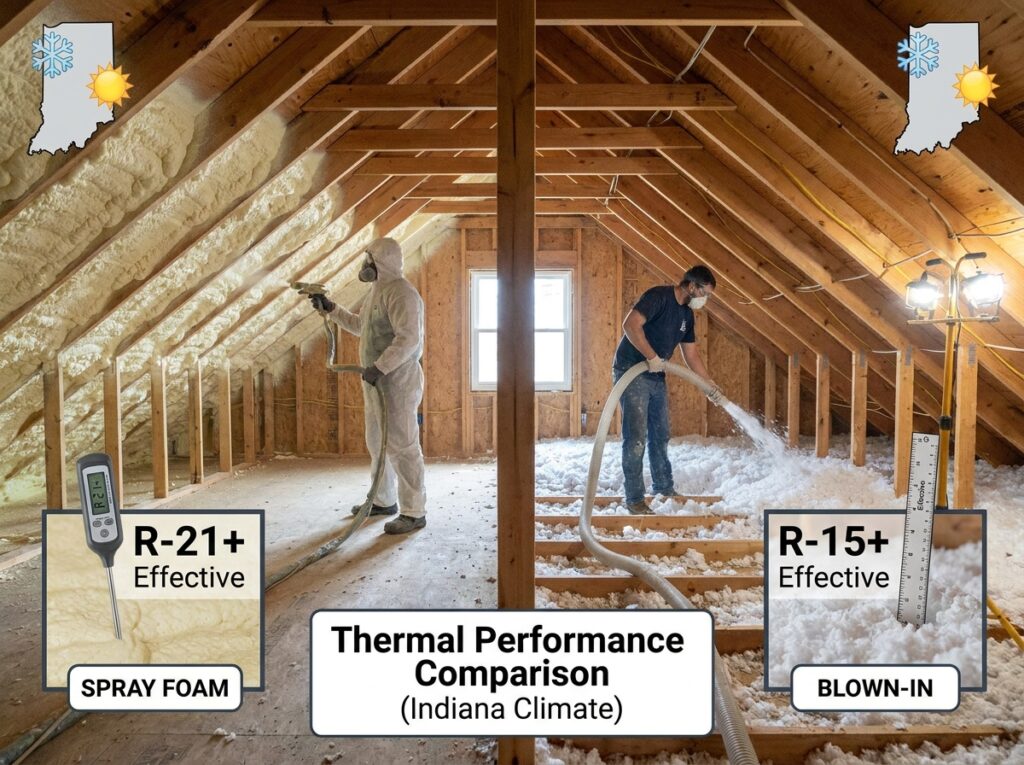
Polyurethane foam delivers higher thermal resistance per inch than cellulose insulation or fiberglass insulation. Closed-cell foam achieves R-6.5 to R-7 per inch, allowing Indiana homes to meet building code insulation requirements with thinner applications. In contrast, blown cellulose provides R-3.2 to R-3.8 per inch, requiring greater thickness to achieve equivalent thermal resistance ratings.
Indiana’s climate zone 5 designation requires attic insulation R-values of R-49 to R-60, according to 2024 building codes. Achieving R-49 requires 7 inches of closed-cell spray foam versus 15 inches of dense-pack cellulose. Open-cell SPF needs approximately 14 inches for the same thermal efficiency, similar to loose-fill cellulose depth requirements.
Spray foam insulation for existing Indiana homes eliminates thermal bridging through studs and joists. The continuous thermal envelope reduces heat loss prevention gaps by 24% compared to blown-in insulation, per thermal imaging studies conducted by energy consultants in Midwest insulation markets. This advantage proves particularly valuable during Indiana winters when heating costs rise substantially.
How Do Installation Costs and ROI Compare Between Spray Foam and Blown-In Insulation?
Spray foam insulation cost Indiana averages $1.50 to $3.50 per square foot installed, whereas blown-in insulation cost Indiana ranges from $0.75 to $1.50 per square foot. For a typical 1,500-square-foot attic, spray polyurethane foam installation expenses total $2,250 to $5,250, while blown-in fiberglass or cellulose costs $1,125 to $2,250.
Return on investment calculations favor different materials based on application. Spray foam insulation ROI reaches break-even in 7-10 years through energy savings potential and utility bill reduction, according to certified installers tracking heating and cooling efficiency improvements. Blown-in insulation vs spray foam ROI shows cellulose achieving payback in 3-5 years due to lower upfront costs.
Indiana utility company insulation rebates and energy rebate programs offset initial installation expenses. Duke Energy and NIPSCO offer $50-$200 rebates for attic insulation upgrades meeting energy efficient insulation standards. Spray foam insulation energy rebates Indiana programs require blower door test verification of air infiltration control improvements. Additional spray foam insulation tax credits Indiana may apply under federal energy conservation incentives through 2032.
Which Insulation Provides Superior Moisture Control and Air Sealing?
Closed-cell spray foam for Indiana basements creates an integrated vapor barrier, preventing condensation and mold growth in humid Indiana summers. The material’s 0.8 to 1.0 perm rating blocks moisture transmission, whereas cellulose and fiberglass remain breathable at 50+ perms, requiring separate moisture barrier protection systems.
Air sealing with spray foam Indiana eliminates cold air infiltration without additional weatherization steps. The polyurethane foam expands to fill cracks, gaps, and irregular cavities, reducing air leakage by 60-80% according to blower door test measurements. In contrast, blown cellulose requires separate air barrier systems using caulk, spray foam sealant, or housewrap to achieve comparable air tightness.
Mold resistant insulation Indiana homes need addresses the state’s 75-80% average summer humidity. Dense-pack cellulose treated with borates offers pest resistance and mold prevention properties, but remains vulnerable to moisture accumulation without proper ventilation and vapor retarder installation. Open-cell spray foam attic insulation Indiana allows some moisture permeability while still providing superior humidity control compared to loose-fill alternatives.
What Are the Durability and Lifespan Differences?
Spray foam insulation lifespan Indiana exceeds 80 years with zero performance degradation, maintaining original R-value and air sealing effectiveness. The cured polyurethane remains dimensionally stable, with no settling issues affecting long-term performance. Closed-cell formulations resist water absorption and maintain structural integrity even during basement flooding events.
Does blown-in insulation settle over time? Yes—cellulose settles 15-20% within the first five years, requiring insulation retrofitting to restore design R-values. Loose-fill fiberglass settles 2-4%, showing better dimensional stability than cellulose but still experiencing gradual compression. How long does blown-in insulation last? Properly installed blown cellulose or fiberglass lasts 20-30 years before requiring replacement or supplementation.
Fire resistance ratings differ significantly between materials. Cellulose receives Class 1 fire rated insulation status due to borate treatments. Spray foam requires flame retardant additives and intumescent coatings in some applications per building code compliance requirements. Both materials demonstrate adequate fire resistance for residential insulation applications when installed by insulation professionals following manufacturer specifications.
Best Use-Case Scenarios for Each Insulation Type
Choose Spray Foam For:
- Basement insulation spray foam vs blown-in: Rim joist insulation and foundation walls benefit from integrated moisture barriers preventing condensation prevention failures
- Crawl space insulation Indiana recommendations: Closed-cell foam seals earthen crawlspaces against humidity and radon infiltration
- Wall insulation choices: Retrofitting insulation in Indiana homes with limited cavity depth maximizes R-value per inch
- HVAC optimization: Reducing air leakage improves heating and cooling efficiency by 20-40%
Choose Blown-In Insulation For:
- Best insulation type for Indiana attic: Attic insulation options Indiana homes prioritize cost-effectiveness over air sealing when attic floor is properly sealed separately
- Insulation for old homes in Indiana: Dense-pack cellulose fills wall cavities in existing construction without major demolition
- Soundproofing insulation spray foam vs blown-in: Cellulose provides superior sound dampening at 44 STC rating versus spray foam’s 39 STC
- Eco-friendly insulation materials: Recycled cellulose offers lower environmental impact and minimal off-gassing compared to polyurethane foam VOCs
Decision Framework: Which Insulation Is Better for Your Indiana Home?
Choose spray foam insulation if: You need maximum thermal performance in limited space, require integrated moisture control for basements or crawlspaces, want permanent air sealing without settling, and can justify higher upfront costs for long-term energy savings and home value increase.
Choose blown-in insulation if: You’re insulating large attic areas where cost effectiveness matters most, can implement separate air sealing solutions, prefer eco-friendly materials with lower VOCs, and want faster return on investment through reduced heating bills and lower cooling costs.
The most energy efficient insulation for Indiana homes depends on specific applications. An energy audit conducted by home performance specialists identifies air leakage locations and insulation coverage gaps. Many Indiana insulation contractors recommend hybrid approaches: spray foam vs blown-in insulation strategies combine closed-cell foam for air sealing critical areas like rim joists with cost-effective blown cellulose for attic spaces, optimizing both building envelope sealing and installation cost considerations.
Professional insulation services provide thermal imaging analysis, blower door testing, and building performance assessments. Hiring insulation contractor Indiana experts ensures proper installation techniques, adequate ventilation systems, and compliance with Indiana building code insulation requirements for both new construction insulation Indiana recommendations and home weatherization retrofit applications.