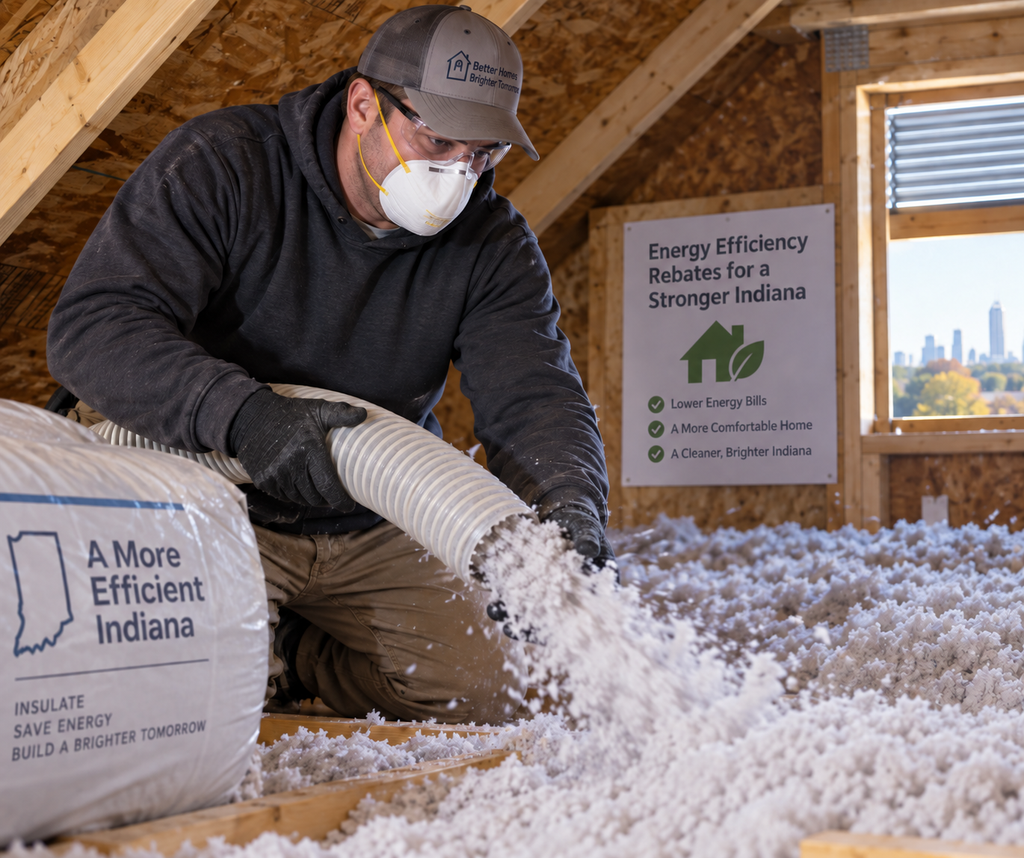
Yes, utility rebates for insulation are worth pursuing in Central Indiana if you use a licensed contractor, meet qualifying R-value thresholds, and complete a required home energy audit first. AES Indiana, Duke Energy Indiana, and CenterPoint Energy all offer cash back rebates for attic insulation upgrades and air sealing in 2025, typically covering 10%–30% of project costs. Combined with federal tax credits under the Inflation Reduction Act (IRA), homeowners in Indianapolis and surrounding counties can reduce net insulation costs by hundreds of dollars. This guide breaks down exactly what qualifies, how much each utility pays, and whether the math works for your specific home.
What You Get: Utility Rebates for Insulation in Central Indiana
Electric utility programs and natural gas rebates in this region are structured as energy conservation measures — meaning they only pay for improvements that demonstrably reduce energy use. Utilities fund these programs because reducing peak demand is often cheaper than building new generation capacity, so the rebate dollars are tied directly to verified performance gains, not just material purchases.
Included in Most Rebate Programs
- Attic insulation upgrades to a qualifying R-value (commonly R-49 or higher in Central Indiana climate zones, which fall under IECC Climate Zone 5)
- Air sealing performed alongside insulation to reduce air leakage and prevent heat loss through gaps, penetrations, and recessed lighting
- Cellulose insulation or fiberglass batt installation in attics and accessible wall cavities
- Blower door test results (before/after) to verify air sealing effectiveness, usually expressed in cubic feet per minute (CFM50)
- A required home energy audit or home performance assessment, sometimes rebated separately at $50–$100
- Attic hatch and duct sealing in some Duke Energy and AES Indiana bundled programs, when performed in the same visit
Typically Excluded or Requires Add-On Rebates
- Spray foam insulation — often eligible, but at a lower per-square-foot rebate rate than cellulose because of higher material cost per R-value point
- HVAC efficiency upgrades — usually a separate rebate category, not bundled with insulation, though some homeowners qualify for both in the same year
- Crawlspace or basement rim joist insulation — covered by some Johnson County REMC and Hendricks Power Cooperative programs, but not all investor-owned utilities
- New construction insulation — most rebates target existing homes only, since new builds must already meet Indiana’s current energy code
- Do-it-yourself installation — nearly all Central Indiana utility rebates require a licensed, program-approved contractor for quality assurance
Cost Breakdown: AES Indiana, Duke Energy Indiana & CenterPoint Energy Rebates
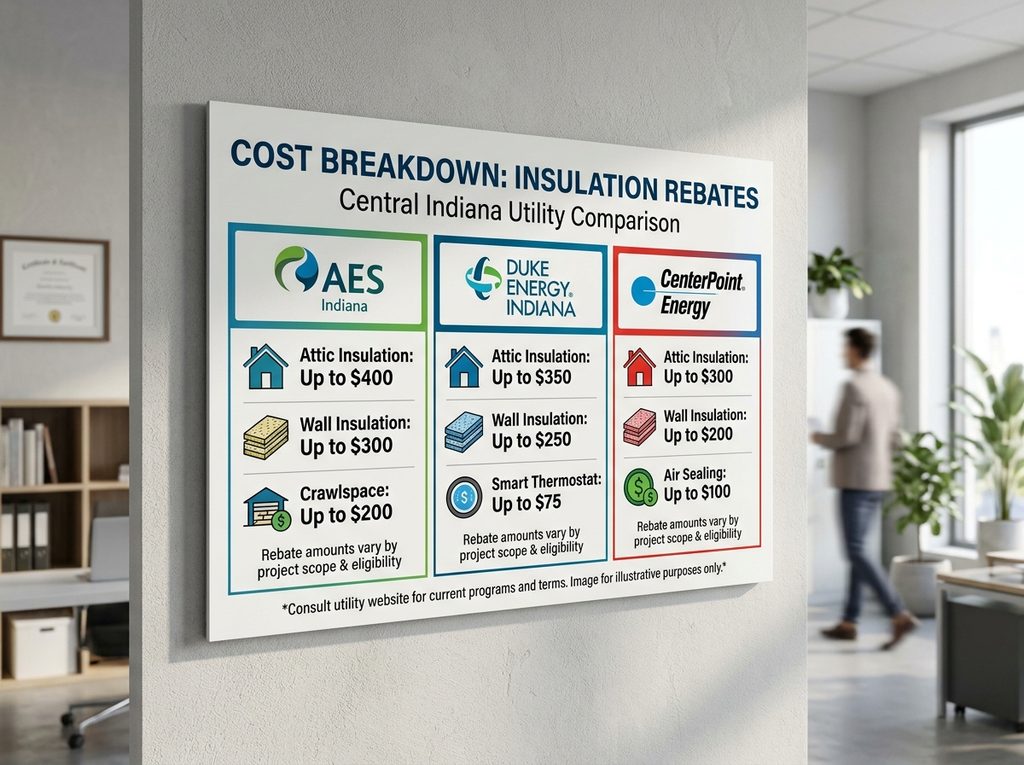
Rebate amounts vary by utility provider, insulation type, and measured R-value improvement. Below is a 2025 snapshot for Central Indiana ratepayers, based on published program guides as of early 2025.
Does CenterPoint Energy Offer Insulation Rebates in Indiana?
Yes. CenterPoint Energy’s natural gas efficiency program offers rebates for attic insulation upgrades that raise R-value from below R-30 to R-49 or greater, typically $0.15–$0.25 per square foot as of 2025. For a typical 1,200 square foot attic, that translates to roughly $180–$300 back, paid as a bill credit within one to two billing cycles after approval.
How to Apply for AES Indiana Insulation Rebates
- Schedule a home energy audit through an AES Indiana-approved energy advisor (often discounted or free for enrolled customers)
- Receive a report identifying qualifying insulation improvements and current R-value, along with a punch list of air sealing targets
- Hire a participating contractor to install insulation and complete air sealing according to the audit recommendations
- Submit the rebate application with contractor invoice, itemized material costs, and blower door test results
- Receive rebate payment (check or bill credit) within 6–8 weeks; keep copies of all paperwork in case of an audit review
Duke Energy Insulation Rebate Central Indiana
Duke Energy Indiana’s Home Energy House Call program offers a no-cost or low-cost home performance assessment, followed by rebates of $150–$400 for qualifying attic insulation projects, depending on square footage and prior R-value. Homeowners with the lowest starting R-values (R-11 or below) typically qualify for the highest rebate tier because the measured energy savings are greatest.
Rebate Comparison Table (2025 Estimates)
| Utility Provider | Rebate Type | Typical Amount | Audit Required? |
|---|---|---|---|
| AES Indiana | Attic insulation + air sealing | $0.10–$0.30/sq ft | Yes |
| Duke Energy Indiana | Attic insulation upgrade | $150–$400 flat | Yes |
| CenterPoint Energy | Natural gas insulation rebate | $0.15–$0.25/sq ft | Recommended |
| Johnson County REMC | Whole-home weatherization | Up to $300 | Yes |
| Hendricks Power Cooperative | Insulation + air sealing bundle | Up to $250 | Yes |
Net cost after rebates: a typical 1,200 sq ft attic insulation upgrade in Indianapolis costs $1,800–$3,200 before incentives, depending on insulation type (cellulose vs. spray foam) and the extent of air sealing needed. After stacking a utility rebate ($200–$400) with the federal insulation tax credit (30% of cost, up to $1,200 annually under the Inflation Reduction Act), net out-of-pocket cost often drops to $1,000–$2,000. Homeowners who also qualify for a REMC bundle can shave off another $150–$300, pushing total savings toward 40%–50% of the original project cost in some cases.
Expected Benefits & ROI Analysis
According to the U.S. Department of Energy (2023), proper attic insulation and air sealing can reduce heating and cooling costs by 10%–20% annually. That range depends heavily on the home’s starting condition, duct location, and local climate — Central Indiana’s cold winters and humid summers make air sealing especially valuable because it addresses both heat loss and heat gain.
- Energy savings: Homes upgrading from R-19 to R-49 in attics typically save 15% on annual HVAC energy use
- Utility bill savings: Average Central Indiana household saves $150–$300 per year post-upgrade, based on a typical 1,800 square foot home with natural gas heat and central air conditioning
- Payback period: Combined rebates and tax credits shorten payback from 8–10 years to 4–6 years
- HVAC efficiency: Reduced air leakage lowers HVAC runtime, extending equipment lifespan by reducing cycling frequency and mechanical wear
- Comfort: Air sealing reduces drafts and temperature swings between floors, particularly in two-story homes with second-floor bonus rooms
- Moisture control: Proper attic ventilation paired with insulation reduces the risk of ice dams in winter and condensation-related mold growth
Energy Star-certified insulation materials and installation practices are required or preferred by most Central Indiana utility programs, ensuring measurable qualifying R-value gains. Homeowners should ask contractors for documentation showing the installed R-value meets or exceeds program minimums, since underperforming installations can result in a denied rebate claim.
Who Should Invest — and Who Shouldn’t
Good Candidates
- Homeowners in Indianapolis or Central Indiana with attics below R-30
- Owners of homes built before 2000, where original insulation levels rarely meet current standards
- Households experiencing high heating/cooling bills or uneven room temperatures between floors
- Anyone planning to sell within 5 years — insulation upgrades are a documented value-add that appraisers and buyers increasingly ask about
- Homeowners who already scheduled a home energy audit and received a report showing insulation as the top-recommended upgrade
Poor Candidates
- Homes with attics already at or above R-49 with no air sealing issues identified by a blower door test
- Renters without landlord approval — most rebates require homeowner enrollment and utility account ownership
- New construction homes already built to current Indiana energy code, where additional insulation offers diminishing returns
- Homeowners planning a full roof or attic renovation within the next year, since insulation work may need to be redone anyway
Alternatives to Consider
Federal Tax Credits and Utility Rebates for Insulation in Indiana
Beyond utility programs, homeowners can combine incentives to further reduce net project cost:
- Inflation Reduction Act Energy Efficient Home Improvement Credit — 30% of insulation costs, up to $1,200 per year, renewable annually if you complete additional efficiency projects in future tax years
- Weatherization Assistance Program — income-qualified households may receive free or subsidized insulation through Indiana Office of Energy Development-administered funds, with eligibility typically set at or below 200% of the federal poverty level
- Insulation tax credits claimed via IRS Form 5695 at tax filing time, requiring a copy of the Manufacturer’s Certification Statement for the installed product
Homeowners who don’t qualify for utility rebates — such as those served by smaller municipal utilities or rural electric cooperatives without active programs — can still access these federal insulation tax credits independently, since the IRA credit is not tied to any specific utility provider.
Qualifying for Central Indiana Energy Efficiency Rebates
Most programs require a professional energy assessment before rebate approval. This typically includes:
- A blower door test measuring current air leakage rate in CFM50
- Attic and wall cavity R-value inspection, often using an infrared camera to spot gaps in existing insulation
- Written scope of work from an Indiana insulation contractor, listing materials, target R-value, and estimated project cost
For homeowners comparing licensed insulation contractors offering utility rebates in Central Indiana, working with an experienced installer familiar with local Indiana insulation rebates paperwork can prevent delays or denied applications. Common denial reasons include missing blower door test data, using a non-approved contractor, or installing insulation below the program’s minimum qualifying R-value.
Final Verdict: Is It Worth It?
Utility rebates for insulation are worth it in Central Indiana for most pre-2000 homes with attic R-values below current Energy Star recommendations. The combination of AES Indiana, Duke Energy Indiana, and CenterPoint Energy rebates with federal tax credits typically cuts net project costs by 25%–45%.
Before committing to a project, run through this quick checklist:
- ✅ Confirm your utility provider (AES Indiana, Duke Energy Indiana, CenterPoint Energy, or a local REMC) and check its current insulation rebate offering
- ✅ Schedule a home energy audit to document your existing R-value and identify air sealing needs
- ✅ Get quotes from at least two program-approved contractors and compare installed R-value, not just price
- ✅ Confirm the contractor will provide a blower door test before and after installation
- ✅ Ask whether the project qualifies for both the utility rebate and the federal IRA tax credit
- ✅ Save all invoices, test results, and Manufacturer’s Certification Statements for tax filing and rebate submission
Skip it only if your attic is already well-insulated, you’re renting without owner buy-in, or your home was recently built to code. For everyone else, a home energy audit followed by insulation upgrades and air sealing remains one of the highest-ROI residential energy conservation measures available in 2025.