
Indiana homeowners face unique thermal efficiency challenges due to the state’s classification as Climate Zone 5, experiencing significant heating degree days during winter months and moderate cooling requirements in summer. Understanding recommended R-values for residential insulation has become increasingly important as energy conservation standards evolve and utility costs continue rising. The Department of Energy (DOE) and International Energy Conservation Code (IECC) provide specific insulation recommendations to ensure building thermal performance meets current energy code compliance requirements.
This comprehensive guide examines optimal insulation levels for Indiana homes, addressing both attic R-value requirements and wall R-value specifications. Homeowners working with insulation contractors or planning DIY weatherization projects will discover practical information about thermal resistance values, insulation materials comparison, and cost benefit analysis. Indiana building code requirements combined with utility incentives from Duke Energy Indiana, Indiana Michigan Power, NIPSCO, and CenterPoint Energy make proper insulation upgrades financially advantageous for residential properties.
If you’d rather skip the math and get a straight answer for your specific home, Homeward Insulation offers free in-home assessments across the Indianapolis metro that pinpoint your exact R-value gap.
Indiana Climate Zone Requirements Determine Residential Insulation Standards
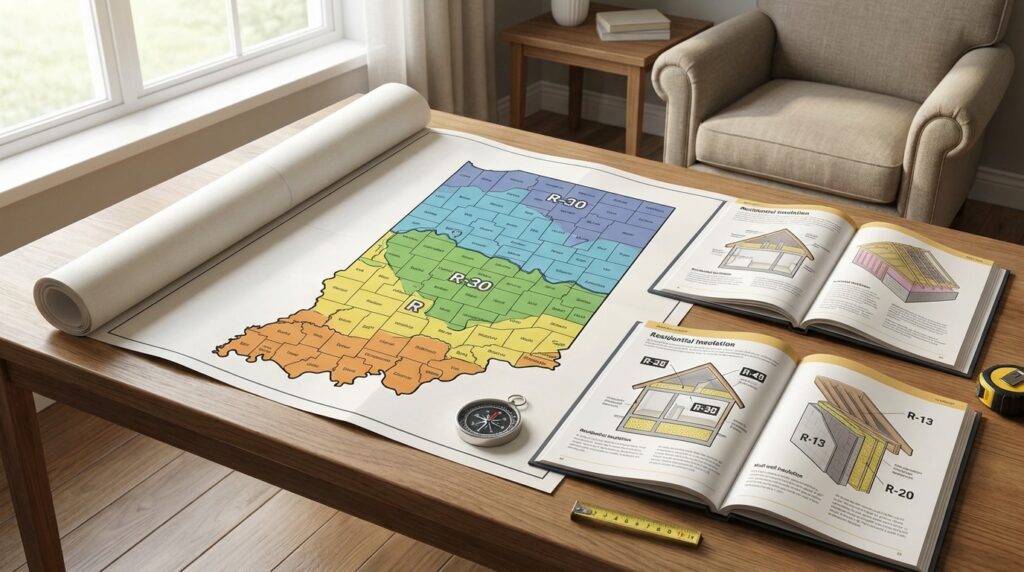
Indiana’s designation as Zone 5 by the IECC establishes specific minimum R-value requirements for building envelope efficiency. The DOE recommends attic insulation levels between R-49 and R-60 for optimal thermal protection, significantly higher than older construction standards. These recommendations account for heating degree days exceeding 5,000 annually in northern Indiana regions, where heat loss prevention becomes critical for home energy efficiency.
The Energy Star program, administered by the EPA, aligns with these climate zone requirements while encouraging above code insulation for enhanced energy savings potential. Wall insulation R-value specifications for Indiana homes require minimum R-21 for 2×6 wall cavities or R-15 for 2×4 wall construction with proper air sealing. Building science research demonstrates that meeting these recommended insulation levels reduces heating and cooling efficiency losses by 30-50% compared to homes with inadequate thermal resistance.
What Are the Specific R-Value Requirements for Indiana Attics?
The Indiana building code mandates minimum attic R-value of R-49 for new construction and major renovations. However, home performance specialists recommend targeting R-60 in attic floor insulation for optimal energy modeling results and long-term utility cost reduction. This translates to approximately 16-20 inches of blown-in insulation or 14-18 inches of fiberglass batt insulation, depending on insulation density and material thermal conductivity.
Attic insulation depth requirements vary slightly based on insulation type selection. Cellulose insulation achieves R-49 at approximately 13-14 inches due to superior density, while fiberglass insulation requires greater thickness. Spray foam insulation delivers higher R-value per inch, reaching R-49 with only 8-9 inches of closed cell application, though installation costs remain substantially higher than conventional blown-in attic insulation options. If blown-in cellulose is the better fit for your attic’s depth and budget, our blown-in insulation team can get most Indianapolis attics to the R-38–R-49 range without the higher spray-foam price tag.
Wall R-Value Specifications Address Building Envelope Thermal Performance
Indiana wall insulation standards require homeowners to achieve R-15 minimum for standard 2×4 wall cavities or R-21 for 2×6 construction in residential applications. The IECC provisions account for thermal bridging through wall studs, recommending continuous insulation or advanced framing techniques to minimize heat transfer reduction effectiveness. Proper wall cavity insulation combined with effective air barrier systems creates comprehensive thermal protection essential for Indiana’s variable climate conditions.
Exterior wall insulation approaches include traditional batt insulation installation, blown-in insulation for existing home insulation upgrades, or spray foam for superior air sealing performance. Mineral wool and rockwool products offer excellent fire resistance alongside thermal resistance values, making them increasingly popular for wall insulation applications. Rigid foam insulation provides continuous thermal protection when installed as exterior sheathing, reducing thermal bridging by 20-40% compared to cavity-only insulation strategies. For existing walls where opening up cavities isn’t practical, dense-pack wall insulation is one of the retrofit-friendly options homeowners use to close that same thermal-bridging gap.
How Do Different Insulation Materials Compare for Indiana Walls?
| Insulation Type | R-Value Per Inch | Best Application | Relative Cost |
|---|---|---|---|
| Fiberglass Batt | R-3.2 to R-3.8 | Standard wall cavities | Low |
| Blown-in Cellulose | R-3.6 to R-3.8 | Retrofit applications | Moderate |
| Spray Foam (Closed Cell) | R-6.0 to R-7.0 | Air sealing priority | High |
| Mineral Wool | R-3.8 to R-4.2 | Fire resistance needed | Moderate-High |
Energy Rebates and Tax Credits Support Insulation Upgrades
The Inflation Reduction Act provides substantial tax credits for homeowners investing in energy efficient insulation improvements meeting Energy Star certification standards. Indiana residents can claim up to 30% of installation costs for qualifying insulation projects, with annual limits applying to total home energy efficiency investments. These federal incentives complement utility company rebate programs offered by Duke Energy Indiana, NIPSCO, CenterPoint Energy, and Indiana Michigan Power.
State-specific weatherization programs administered through local agencies provide additional financial assistance for income-qualified homeowners seeking insulation upgrades. A home energy audit using thermal imaging technology helps identify specific areas requiring improved thermal resistance, enabling targeted retrofit insulation options with maximum ROI on insulation investments. Combining available energy rebates with proper insulation installation creates payback periods typically ranging from 3-7 years for comprehensive attic and wall improvements.
What Financial Incentives Are Available for Indiana Homeowners?
- Federal Tax Credits: 30% of qualified insulation costs under Inflation Reduction Act provisions through 2032
- Utility Company Rebates: $100-$500 rebates from Duke Energy Indiana, NIPSCO, and other providers for documented insulation improvements
- State Weatherization Programs: No-cost insulation upgrades for income-eligible Indiana households through energy assistance programs
- Local Incentives: Municipal programs offering additional support for energy code compliance and building thermal performance enhancement
Frequently Asked Questions
What is the recommended attic R-value for Indianapolis homes?
Indianapolis homeowners should target R-49 to R-60 for attic insulation to meet current DOE recommendations for Climate Zone 5. This level provides optimal thermal protection for Indiana’s heating and cooling requirements, reducing energy costs by 30-40% compared to older R-30 standards common in homes built before 2000. Pairing that R-49–R-60 depth with a radiant barrier is another option for cutting summer cooling costs further — our radiant barrier insulation crews can install one alongside your attic upgrade.
How much does it cost to upgrade attic insulation to recommended R-values?
Professional attic insulation installation typically costs $1.50-$3.50 per square foot for blown-in cellulose or fiberglass achieving R-49 to R-60 levels. A standard 1,200 square foot attic insulation upgrade ranges from $1,800-$4,200, with spray foam options costing $3,000-$7,000 due to higher material and labor expenses.
Can I install wall insulation in my existing Indiana home?
Yes, retrofit insulation options include blown-in cellulose or fiberglass installed through small exterior holes that are subsequently sealed. This approach allows existing home insulation upgrades without removing interior walls, typically achieving R-13 to R-15 in standard 2×4 wall cavities for approximately $2-$4 per square foot of wall area.
Does Indiana require vapor barriers with insulation installation?
Indiana building code requires vapor barriers on the warm-in-winter side of wall and ceiling insulation in heated spaces. For most applications, this means kraft-faced batt insulation or separate polyethylene sheeting installed toward interior living spaces to prevent moisture control problems and condensation within building assemblies.
What insulation type works best for Indiana’s climate conditions?
Blown-in cellulose insulation offers excellent cost-effectiveness and thermal efficiency for Indiana homes, providing superior air sealing compared to fiberglass batts. For maximum performance addressing both heating degree days and cooling requirements, closed-cell spray foam insulation delivers superior R-value per inch with integrated moisture management and air barrier properties.
Should I perform a home energy audit before upgrading insulation?
Professional home energy audits using thermal imaging identify specific heat loss locations and prioritize cost-effective improvements. Indiana utility companies often subsidize these assessments, providing detailed reports showing where insulation upgrades deliver maximum energy savings potential and helping homeowners qualify for available rebate programs and tax credit eligibility. An audit will also flag whether your attic needs better ventilation — our attic insulation services Indianapolis include attic fan installation to keep newly upgraded insulation performing as designed.